Unified Data Model
Today, customer-facing teams tend to live in silos across dozens of tools. Most of these platforms either lock you into static CRM objects or leave you building everything yourself - this is no longer enough. Planhat gives you conversations, collaboration, enablement and CRM data all in one place - flexibly ingested and automatically enriched. It’s a living home for your commercial activity, not just a store of record.
01
Mirror your business
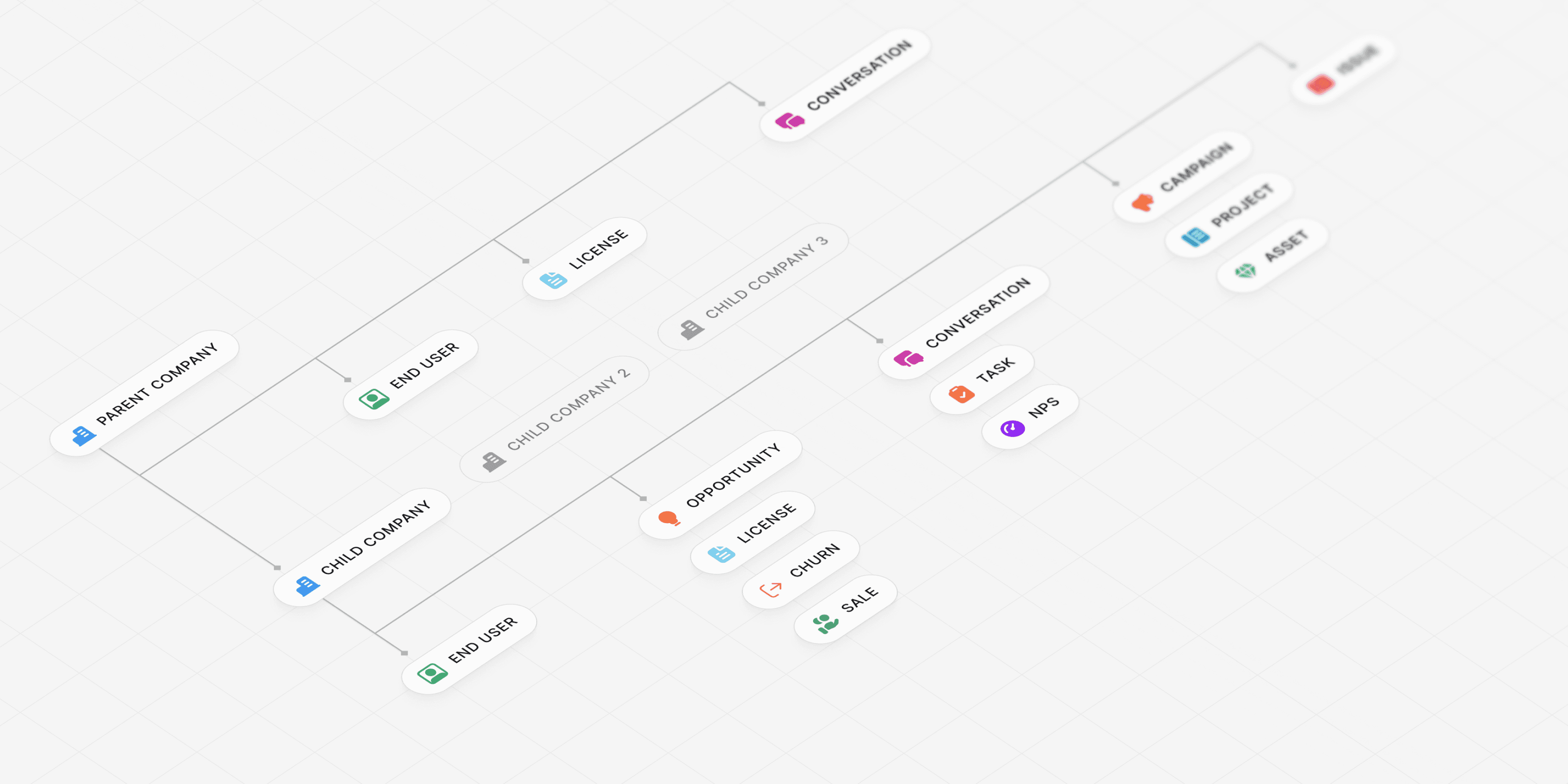
Start with pre-built models like companies, end users, opportunities, and licenses, and add custom fields and generic models for whatever else you track - physical assets, shared objectives, or custom processes. Adapt them to your needs, enrich them, and apply automations.
02
Bring conversations and collaboration into the core
Emails, tickets, call transcripts, meeting notes, and shared documents live natively alongside your CRM data. They’re automatically summarised, searchable, and tied to the right customers or other commercial objectives.
03
Roll up data across complex hierarchies
Set up parent-child relationships (portfolios, regions, resellers) and automatically aggregate revenue, health scores, usage, open issues, or any custom metric to the customer - giving you a single view of the most important information.
Power your every process.


What makes the Unified Data Model different from a standard CRM data structure?
Unlike traditional CRMs that store static, siloed objects, Planhat's Unified Data Model is time-aware. It serves as a single, connected home for all commercial data — integrating product usage, communications, and financial milestones into a living model that reflects the current state and trajectory of every customer relationship.
How does the Unified Data Model make automation reliable across thousands of accounts?
Automation is only as reliable as the data feeding it. The Unified Data Model standardises disparate signals from across the tech stack into a consistent semantic structure — whether it's an onboarding event or a billing milestone — so that Workflows trigger on accurate, structured data rather than raw, unprocessed inputs.
How does the model connect a trend in the data to a concrete response?
Most platforms show a chart and stop there. Planhat's Unified Data Model connects behavioural signals — like a drop in adoption — directly to commercial context like NRR, so when the model detects a meaningful shift, it can feed that signal into an automated risk-mitigation Workflow rather than just updating a dashboard.
How does Planhat manage data noise in complex, multi-source environments?
Scaling organisations produce enormous volumes of data with low signal-to-noise ratios. The Unified Data Model applies operational filtering and normalisation across millions of time-series events, structuring them around commercial relevance so that commercial teams and AI workflows focus on the signals that actually drive onboarding success, adoption, and expansion.
How does the Unified Data Model support AI governance and trustworthy predictions?
AI is only as good as the data it consumes. By enforcing strict data semantics and clean relationships between accounts and users, the Unified Data Model provides the high-fidelity foundation required for reliable AI-driven predictions — from churn forecasting to next best action recommendations — with data governance built directly into the model.